Best 15-Needle Embroidery Machines: 5 Commercial Picks
Disclosure: As an Amazon Associate I earn from qualifying purchases. If you buy through links on this page, we may earn a small commission at no extra cost to you.
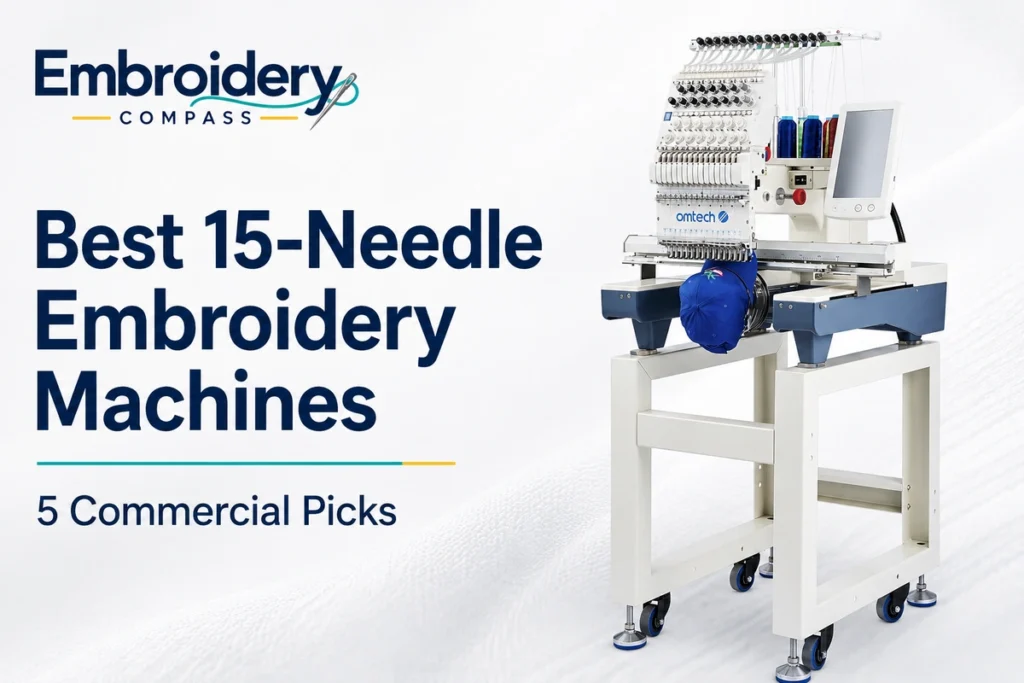
A 15-needle embroidery machine can transform the workflow of a growing embroidery business. Instead of stopping to rethread one needle every time a design changes color, you can keep a broad palette ready and let the machine move automatically between loaded thread colors.
That advantage becomes increasingly important when you are producing customer logos, hats, uniforms, jackets, bags and repeated apparel orders. But choosing among the best 15-needle embroidery machines involves more than simply finding the machine with the highest advertised speed.
Embroidery area, single-head versus dual-head design, cap capability, touchscreen controls, design transfer, automatic trimming, support and the physical size of the machine all affect how well it fits a real business.
Based on our comparison, our best overall 15-needle embroidery machine is the OMTech Pulse. It combines a large 13″ x 19.7″ embroidery field, Wi-Fi and USB design transfer, a 10-inch touchscreen, 270-degree cap capability and a relatively approachable commercial platform.
The PooLin EOM is our value-oriented single-head choice, while the Ricoma Swift 1501 provides a more premium commercial workflow. Businesses ready to increase output further can consider the INTSUPERMAI dual-head machine or BAI Vision 2-Head, which allow two items to be embroidered during the same production cycle.
Best 15-Needle Embroidery Machines at a Glance
| Embroidery Machine | Best For | Heads | Embroidery Area | Max Speed |
|---|---|---|---|---|
| OMTech Pulse | Best Overall | 1 | 13″ x 19.7″ | 1,000 SPM |
| PooLin EOM | Best Value | 1 | 14″ x 9.5″ | 1,000 SPM |
| Ricoma Swift 1501 | Best Premium Single-Head | 1 | 20.5″ x 13.8″ | 1,200 SPM |
| INTSUPERMAI Dual-Head | Best Value Dual-Head | 2 | 15.7″ x 19.6″ | 1,000 SPM |
| BAI Vision 2-Head | Best High-Volume Dual-Head | 2 | 15.7″ x 19.7″ | 1,200 SPM |
All five machines provide 15-needle commercial embroidery capability, but they are not intended for exactly the same buyer. The single-head machines make more sense for many first commercial setups, while the dual-head models become more attractive when order volume is high enough to keep two embroidery heads working productively.
How We Chose the Best 15-Needle Embroidery Machines
This guide is more specific than our broader best embroidery machines for small business comparison. Here, every recommendation is centered on the advantages and tradeoffs of moving into a 15-needle commercial workflow.
We considered the following factors:
- Needle capacity: Fifteen needle positions allow a broad thread palette to remain loaded for multi-color work.
- Number of heads: A dual-head machine can potentially embroider two compatible items during the same production run.
- Embroidery area: Larger fields provide more room for jackets, bags, oversized logos and other commercial projects.
- Embroidery speed: Higher stitch rates can shorten machine time, although actual production speed depends on the design and material.
- Cap capability: Hat businesses need dedicated cap frames or drivers rather than relying only on flat hoops.
- Automatic color changes: This is one of the primary productivity advantages of a multi-needle machine.
- Automatic thread trimming: Less manual cleanup can improve workflow across repeated orders.
- Thread-break detection: A machine that identifies a problem quickly can help reduce wasted production time.
- Design transfer: USB, Ethernet and Wi-Fi options affect how efficiently designs move from the computer to the machine.
- Controls: A larger touchscreen can make design selection, positioning and production management easier.
- Business scalability: We considered whether each machine is better suited to a first commercial setup or higher-volume production.
Embroidery Compass bases these recommendations on manufacturer specifications, documentation, feature comparisons and practical buying considerations. We do not describe a machine as personally tested unless hands-on testing has actually taken place.
1. OMTech Pulse — Best Overall 15-Needle Embroidery Machine

Best for: Small and growing embroidery businesses that want a versatile single-head 15-needle machine for apparel, hats, bags and larger designs.
The OMTech Pulse earns our best overall position because it brings together the features most businesses actually need without immediately requiring a dual-head production setup.
It provides 15 needles, a substantial 13″ x 19.7″ embroidery area and adjustable embroidery speeds up to 1,000 stitches per minute. That working area is large enough for much more than basic left-chest logos and gives the machine useful flexibility for jackets, hoodies, bags and other larger projects.
The Pulse also includes Wi-Fi and USB connectivity, a 10-inch color touchscreen, automatic thread cutting, automatic color changes and thread-break detection.
Why the OMTech Pulse Stands Out
A first commercial embroidery machine needs to provide meaningful production advantages without adding capacity that the business may never use.
For many small shops, one 15-needle head is enough to make a major difference. You can load commonly used colors, program the design sequence and allow the machine to move between those needles automatically.
This provides the multi-color automation businesses want while keeping the workflow simpler than a dual-head machine.
13″ x 19.7″ Embroidery Area
The Pulse’s 330 x 500 mm working area—approximately 13″ x 19.7″—is one of its strongest specifications.
A large embroidery field can be particularly useful when you want to expand beyond small personalization jobs into products such as:
- Jacket backs
- Large hoodie designs
- Tote bags
- Team apparel
- Workwear
- Uniforms
- Large patches
- Decorative home products
A large field does not mean every design should be oversized, but it prevents the machine from becoming the limitation when a customer requests something larger.
Cap-Ready Commercial Setup
OMTech provides a 270-degree cap system, allowing the machine to handle hats in addition to flat garments.
This matters because many embroidery businesses eventually receive requests for corporate caps, team hats and branded headwear. A machine that can move between flat work and caps provides more opportunities to serve the same customer.
If caps are your primary product rather than one part of the business, our best embroidery machines for hats guide goes deeper into cap-specific considerations.
OMTech Pulse Key Specifications
- Needles: 15
- Heads: 1
- Maximum embroidery area: 13″ x 19.7″ / 330 x 500 mm
- Maximum listed speed: 1,000 SPM
- Touchscreen: 10 inches
- Connectivity: Wi-Fi / USB
- Cap rotation: 270°
- Automatic color change: Yes
- Automatic thread cutting: Yes
- Thread-break detection: Yes
- Positioning aid: Red-light positioning
- Design memory: Up to 20 million stitches / 200 designs
What Could Be Better
The Pulse is limited to one embroidery head. That is completely adequate for many growing businesses, but it cannot produce two identical garments simultaneously the way a dual-head machine can.
Its 1,000-SPM maximum speed is also lower than the 1,200-SPM maximum of the Ricoma Swift and BAI Vision in this comparison. However, embroidery speed should not be judged in isolation because color changes, hooping, trimming, design complexity and operator workflow also affect total production time.
Our verdict: The OMTech Pulse offers the strongest overall balance in this comparison. Its 15 needles, large embroidery area, cap support, modern connectivity and automated workflow make it a logical first serious commercial machine for many growing embroidery businesses.
2. PooLin EOM — Best Value 15-Needle Embroidery Machine

Best for: New commercial users who specifically want 15 needles but prefer a smaller single-head platform before investing in larger production equipment.
The PooLin EOM is our value-oriented choice because it packages the key advantages of a commercial 15-needle machine into a comparatively compact single-head system.
It provides a maximum embroidery field of approximately 14″ x 9.5″, maximum speed up to 1,000 stitches per minute, a 9-inch touchscreen and Wi-Fi/USB design transfer.
PooLin also uses its Institch OS4 control system, with automatic color changes and thread-break detection helping reduce operator intervention during multi-color jobs.
Why the EOM Stands Out as a First 15-Needle Machine
Moving directly from a single-needle home machine to large industrial equipment can be intimidating. The EOM is positioned as a more approachable commercial entry point while still providing the core 15-needle advantage.
For a new embroidery business, that can be more useful than buying the largest machine available before customer demand has been established.
Fifteen needles give the operator enough positions to establish a practical permanent thread palette. Common colors can remain loaded while less frequently used colors are changed as needed.
Compact Commercial Footprint
PooLin lists the EOM machine itself at approximately 23.6″ x 28.3″ x 31.9″ before considering its stand and operating clearance.
That compact machine body can be attractive to businesses working from home studios, spare rooms or smaller retail spaces where a very large dual-head machine would be difficult to accommodate.
Useful for Hats and Flat Embroidery
PooLin positions the EOM for clothing, hats, patches, bags and other personalized products. That versatility allows a startup to experiment with different products before committing its entire business to one category.
The ability to handle caps can be especially valuable because the same business customer ordering embroidered polos may also want matching hats.
PooLin EOM Key Specifications
- Needles: 15
- Heads: 1
- Maximum embroidery area: 14″ x 9.5″ / 360 x 240 mm
- Maximum speed: 1,000 SPM
- Touchscreen: 9 inches
- Connectivity: Wi-Fi / USB
- Control system: Institch OS4
- Automatic color change: Yes
- Thread-break detection: Yes
- Built-in patterns: 62
- Machine weight: approximately 176 lb
- Hat embroidery capability: Yes
Where the EOM Is More Limited
The EOM’s biggest compromise compared with larger commercial machines is its embroidery area. The 14″ x 9.5″ field is useful for many common business projects, but it does not provide the same large-format flexibility as the OMTech Pulse, Ricoma Swift or dual-head machines in this guide.
It is also a single-head machine, so businesses needing to produce pairs of identical items simultaneously should consider whether a dual-head platform would provide a better return on the additional investment.
Our verdict: The PooLin EOM is our preferred value-oriented 15-needle choice. It provides the key automation of a true multi-needle commercial setup while remaining more approachable for a new business than a large dual-head system.
3. Ricoma Swift 1501 — Best Premium Single-Head 15-Needle Machine

Best for: Business owners who want a mature commercial single-head platform, large embroidery area, strong support ecosystem and faster 1,200-SPM production.
The Ricoma Swift 1501 is our premium single-head choice. It combines 15 needles with a large 20.5″ x 13.8″ embroidery area, speeds up to 1,200 stitches per minute and a 10.1-inch high-definition touchscreen.
Ricoma positions the Swift for businesses moving from outsourcing embroidery into in-house production, which reflects the machine’s balance between professional capacity and single-head manageability.
Why Consider a Premium Single-Head Machine?
A dual-head machine can potentially double output on compatible repeated jobs, but not every business needs two heads.
If your work consists of frequent custom one-offs, different names, changing designs or smaller batches, a high-capacity single-head machine can provide greater flexibility without tying up the investment and floor space associated with a dual-head platform.
The Swift focuses on maximizing the performance of one head rather than simply increasing the number of heads.
20.5″ x 13.8″ Working Area
The Swift provides one of the largest single-head embroidery areas in this comparison.
A 20.5″ x 13.8″ field provides useful space for large designs and gives a business flexibility when moving beyond standard chest logos into jacket backs, bags and oversized apparel embroidery.
270-Degree Cap Rotation
Ricoma specifies 270-degree cap rotation and includes cap-related accessories with its standard machine packages.
That makes the Swift suitable for businesses that want one primary commercial machine for both flat products and hats rather than buying separate equipment for each category.
Ricoma Swift 1501 Key Specifications
- Needles: 15
- Heads: 1
- Maximum embroidery area: 20.5″ x 13.8″
- Maximum speed: 1,200 SPM
- Cap rotation: 270°
- Touchscreen: 10.1-inch HD color display
- Connectivity: USB / Ethernet / Wi-Fi
- File format: DST
- Memory: 100 million stitches or 1,000 designs
- Machine weight: approximately 353 lb
- Cap driver and cap rings: Available/included depending on package
- Automatic commercial workflow: Yes
What Could Be Better
The Swift is a much heavier machine than the compact PooLin EOM, so workspace planning becomes more important.
It also remains a single-head machine. A high-volume shop producing dozens or hundreds of identical garments may obtain more production capacity from a two-head system.
On the other hand, businesses that mainly handle custom work may prefer the flexibility of one premium head rather than having two heads that are not consistently utilized.
Our verdict: Choose the Ricoma Swift when you want a polished premium single-head commercial setup with 15 needles, large embroidery capacity, strong cap support and a mature business-oriented workflow.
4. INTSUPERMAI Dual-Head — Best Value Dual-Head 15-Needle Machine

Best for: Businesses that want to move into dual-head production while prioritizing capacity and specifications over a larger established embroidery-brand ecosystem.
The INTSUPERMAI Dual-Head Commercial Embroidery Machine changes the buying decision because it provides two embroidery heads rather than one.
The platform uses a 15-needle configuration, a large approximately 15.7″ x 19.6″ / 400 x 500 mm embroidery area, speeds up to 1,000 stitches per minute and a 10-inch touchscreen.
Its main appeal is straightforward: when the order is suitable for dual-head production, two matching items can be processed during the same production cycle rather than one after another.
When Two Heads Actually Save Time
A dual-head machine is most useful for repeated orders.
Examples include:
- Company polo orders
- School uniforms
- Team apparel
- Matching caps
- Workwear
- Event merchandise
- Repeated logo embroidery
If both heads are stitching the same compatible design at the same time, production capacity can improve substantially compared with running those items sequentially on one head.
However, businesses producing mostly one-off personalized items should be careful not to assume that two heads automatically means twice the useful productivity.
Large Commercial Embroidery Area
The approximately 400 x 500 mm field provides substantial room for larger projects and puts the machine firmly into commercial-production territory.
That flexibility can be valuable for a shop that produces a mix of uniforms, hoodies, jackets, bags and hats instead of specializing only in small logos.
Automatic Workflow Features
The machine includes automatic thread trimming and automatic color switching, helping reduce repetitive manual steps during production.
It also supports DST and DSB design files and includes USB/Ethernet connectivity for transferring commercial embroidery designs.
INTSUPERMAI Dual-Head Key Specifications
- Machine type: Dual-head commercial embroidery
- Heads: 2
- Needle configuration: 15-needle
- Maximum embroidery area: 15.7″ x 19.6″ / 400 x 500 mm
- Maximum speed: 1,000 SPM
- Touchscreen: 10 inches
- File support: DST / DSB
- Connectivity: USB / Ethernet
- Automatic color change: Yes
- Automatic thread trimming: Yes
- Cap embroidery: 270° support
- Voltage: 110–220V
What to Consider Before Choosing It
Brand support matters much more with commercial embroidery equipment than with a basic hobby machine. Before buying, confirm the exact warranty, technical-support process, replacement-parts availability, training resources and package contents offered by the seller or retailer.
This is especially important for a business because downtime can mean delayed customer orders rather than simply postponing a personal project.
Our verdict: The INTSUPERMAI model is worth considering when dual-head capacity is your priority and you are comfortable carefully evaluating seller support. Its specifications provide substantial production capability, but support and parts availability deserve extra attention before purchase.
5. BAI Vision 2-Head — Best High-Volume Dual-Head 15-Needle Machine

Best for: Established embroidery businesses that already have enough repeated work to keep a dual-head commercial machine productive.
The BAI Vision 2-Head is the most production-oriented machine in this comparison. It combines two heads with a 15-needle commercial system, a large approximately 15.7″ x 19.7″ embroidery area and speeds up to 1,200 stitches per minute.
For a business regularly receiving quantity orders, the ability to produce two compatible pieces in the same run can provide a much more meaningful productivity increase than simply moving from 1,000 to 1,200 SPM on one head.
Dual-Head Production Is the Main Advantage
Imagine an order for 50 embroidered company polos. On a single-head machine, each garment has to be run through the machine individually.
With a properly configured two-head workflow, two compatible garments can be embroidered during the same production cycle. Across a substantial order, reducing the number of machine cycles can make a major difference to turnaround time.
This is why dual-head capacity becomes most valuable after the business has already developed recurring volume.
400 x 500 mm Working Area
BAI specifies a 400 x 500 mm maximum embroidery area, approximately 15.7″ x 19.7″.
This gives the Vision enough room for larger apparel and commercial applications while retaining support for hats and more conventional logo embroidery.
Institch Control and Wireless Transfer
The Vision platform uses BAI’s Institch control system with a 10-inch touchscreen and supports USB/Wi-Fi design transfer.
Wireless transfer can become useful in a commercial environment where designs are prepared away from the machine and need to be moved into production efficiently.
BAI Vision 2-Head Key Specifications
- Heads: 2
- Needles: 15
- Maximum embroidery area: 15.7″ x 19.7″ / 400 x 500 mm
- Maximum speed: 1,200 SPM
- Structured-hat speed: up to approximately 950 SPM
- Control panel: 10-inch Institch system
- Connectivity: USB / Wi-Fi
- Automatic color change: Yes
- Automatic thread trimming: Yes
- Thread-break detection: Yes
- Hat embroidery capability: Yes
- 3D embroidery capability: Yes
Why It Is Not Our Recommendation for Every Business
A dual-head machine is a poor investment if the second head spends most of its time unused.
If you mainly produce custom names, one-off gifts and constantly changing designs, a flexible premium single-head machine may make more financial sense.
The Vision is also physically substantial. A business needs dedicated floor space, suitable access for delivery and enough clearance around the machine for hoops and garments.
Our verdict: The BAI Vision 2-Head is our high-volume recommendation because its two-head configuration, 15-needle workflow, 1,200-SPM maximum speed and large field are designed around production. It makes the most sense after a business has enough recurring orders to utilize both heads consistently.
Single-Head vs Dual-Head 15-Needle Embroidery Machines
Choosing between one and two heads is one of the most important decisions in this category.
| Feature | Single-Head 15-Needle | Dual-Head 15-Needle |
|---|---|---|
| Best for | Custom orders and growing shops | Repeated quantity orders |
| Initial investment | Lower | Higher |
| Floor space | Less | More |
| One-off personalization | Excellent | Can leave capacity unused |
| Batch production | Good | Major advantage |
| Learning complexity | Lower | Higher |
| Potential simultaneous output | 1 item | 2 compatible items |
A dual-head machine should not be considered automatically better. It is better only when the business has enough compatible work to use both heads.
For many first commercial setups, a quality single-head 15-needle machine is the more flexible starting point.
OMTech Pulse vs PooLin EOM vs Ricoma Swift
These three machines are the most direct choices for businesses wanting a single-head 15-needle platform.
| Feature | OMTech Pulse | PooLin EOM | Ricoma Swift |
|---|---|---|---|
| Needles | 15 | 15 | 15 |
| Heads | 1 | 1 | 1 |
| Embroidery Area | 13″ x 19.7″ | 14″ x 9.5″ | 20.5″ x 13.8″ |
| Max Speed | 1,000 SPM | 1,000 SPM | 1,200 SPM |
| Wireless Transfer | Yes | Yes | Yes |
| Best Fit | Balanced commercial setup | Value/startup | Premium single-head |
The PooLin EOM makes the most sense when you want an accessible route into 15-needle embroidery. The Ricoma Swift provides the strongest premium single-head specifications and a larger commercial ecosystem.
For the widest group of growing businesses, however, we prefer the OMTech Pulse because it sits between those two extremes with a large working field and well-rounded commercial feature set.
What Are the Advantages of a 15-Needle Embroidery Machine?
1. More Thread Colors Stay Ready
The most obvious advantage is the ability to keep up to 15 thread colors loaded at once.
A business can create a core palette using colors it reaches for every day—black, white, red, navy, royal blue, gold, gray and others—and leave those threads ready between orders.
This reduces time spent repeatedly removing and rethreading colors.
2. Automatic Color Changes
Once the colors in a design are assigned to needle positions, the machine can automatically move between the loaded needles according to the programmed sequence.
That is a major workflow improvement over single-needle embroidery, where the operator may need to change the thread manually for each color.
3. Better for Repeated Customer Orders
Multi-needle automation becomes especially valuable when you stitch the same design repeatedly.
Once the logo, thread assignments and hoop placement are established, the operator can focus more on preparing the next garment instead of managing every color transition manually.
4. Commercial Cap Systems
Many 15-needle machines are designed around tubular arms and dedicated cap drivers, which makes them much more suitable for regular hat production than many home embroidery machines.
5. Larger Embroidery Areas
Commercial 15-needle machines often provide substantially larger embroidery areas than beginner home machines, expanding the range of products a business can accept.
Do You Really Need 15 Needles?
Not every embroidery business needs a 15-needle machine.
A 10- or 12-needle machine may be completely adequate when most designs use relatively few colors. The main reason to choose 15 needles is not because 15 is inherently professional—it is because the additional thread positions solve a real workflow problem.
Fifteen needles become particularly useful when:
- You regularly stitch multi-color logos
- You want a broad permanent thread palette
- You handle repeated commercial orders
- You frequently switch between different customer designs
- You want to reduce manual rethreading
- You embroider hats and commercial apparel regularly
If you are still deciding between different needle counts, our small-business embroidery machine guide compares 6-, 7-, 10-, 12- and 15-needle options.
How to Choose a 15-Needle Embroidery Machine
1. Choose Single Head or Dual Head First
Do this before comparing small feature differences.
If your business mainly handles customized one-off orders, start by looking at single-head machines. If you already receive repeated uniform, team or corporate orders, a dual-head platform may provide more value.
2. Compare the Real Embroidery Area
Do not assume every commercial 15-needle machine has the same working field.
The machines in this comparison range from the relatively compact PooLin EOM to fields approaching 20 inches on larger commercial platforms.
Choose based on the largest projects you realistically expect customers to request.
3. Do Not Buy Based on SPM Alone
Maximum stitches per minute is useful, but it is not the same as total production speed.
Your workflow also includes:
- Hooping garments
- Loading and unloading the machine
- Changing bobbins
- Managing thread breaks
- Changing less-common thread colors
- Preparing stabilizer
- Checking design placement
- Finishing and trimming garments
A well-organized 1,000-SPM machine can sometimes produce more finished work than a faster machine surrounded by an inefficient workflow.
4. Evaluate Cap Capability Separately
If hats are important to your business, look at the cap driver, cap-frame package, usable cap area and hat-specific guidance rather than relying only on the flat embroidery specifications.
5. Research Technical Support Before Buying
This is one of the most important differences between buying a commercial embroidery machine and a basic home appliance.
Before purchasing, check:
- Warranty length
- Who provides technical support
- Whether phone/video support is available
- Availability of replacement parts
- Training resources
- Manuals and maintenance documentation
- Whether local technicians are available
- Exactly what accessories are included
A machine that is slightly cheaper can become expensive if it remains out of production while you wait for support or replacement parts.
6. Plan the Workspace Before Delivery
Commercial embroidery machines are much larger and heavier than ordinary home machines.
Measure:
- Doorways
- Hallways
- Ceiling clearance
- Floor space
- Working space around the machine
- Hoop movement clearance
- Distance to a suitable electrical outlet
Dual-head equipment deserves particular attention because it requires significantly more space than a compact single-head machine.
What Else Do You Need With a 15-Needle Machine?
The machine is only part of a commercial embroidery setup.
- Commercial embroidery thread
- Pre-wound or wound bobbins
- Embroidery needles
- Tear-away stabilizer
- Cut-away stabilizer
- Cap backing
- Water-soluble topping where appropriate
- Garment and cap hoops
- Magnetic hoops if desired
- Thread racks and storage
- Maintenance supplies
- Quality blank garments
- Digitized embroidery files
- Embroidery or digitizing software
Our embroidery supplies and accessories guides cover thread, stabilizers, needles, hoops and other materials used in the embroidery workflow.
If you plan to create or substantially edit customer logos yourself, visit our embroidery software guides to learn about digitizing and editing options.
Which 15-Needle Embroidery Machine Fits Your Needs?
Choose the OMTech Pulse if:
You want a balanced single-head commercial machine with a large embroidery area, modern connectivity, cap capability and enough automation to grow a serious small embroidery business.
Choose the PooLin EOM if:
You want an approachable entry into commercial 15-needle embroidery and do not need the largest embroidery field available.
Choose the Ricoma Swift 1501 if:
You want a premium single-head machine with a large field, 1,200-SPM maximum speed, 270-degree cap capability and a more established commercial support ecosystem.
Choose the INTSUPERMAI Dual-Head if:
You want dual-head production capacity at a potentially more accessible entry point and are prepared to carefully evaluate seller support, warranty and replacement-parts availability.
Choose the BAI Vision 2-Head if:
Your business already receives enough repeated orders to benefit from running two heads and you want a production-oriented 15-needle platform with a large field and 1,200-SPM maximum speed.
Frequently Asked Questions
What is the best 15-needle embroidery machine?
Our best overall choice is the OMTech Pulse. It combines 15 needles with a 13″ x 19.7″ embroidery field, 1,000-SPM maximum speed, Wi-Fi and USB transfer, a 10-inch touchscreen and 270-degree cap capability.
Businesses needing higher repeated-order output should also consider a dual-head machine such as the BAI Vision.
Is a 15-needle embroidery machine worth it?
A 15-needle machine can be worth the investment when multi-color embroidery and repeated customer orders are creating too much manual work on a single-needle machine.
Its main advantage is not simply speed. Keeping multiple thread colors loaded and allowing automatic color changes can reduce operator intervention across every multi-color job.
Is 15 needles enough for commercial embroidery?
Yes. Fifteen needles provide substantial color capacity for commercial embroidery and are common on professional single-head and multi-head systems.
Designs containing more than 15 thread colors can still be produced, but some colors may need to be changed during the workflow.
Is a dual-head embroidery machine twice as fast?
Not automatically. A dual-head machine can potentially embroider two compatible items during the same production cycle, which can substantially increase batch output.
However, total production time also includes hooping, loading, unloading, thread management, finishing and other tasks. A second head only creates value when the business has enough suitable work to use it consistently.
Can a 15-needle machine embroider hats?
Many commercial 15-needle machines support hats through dedicated cap drivers and frames. However, cap capability varies between machines and packages, so always confirm which cap accessories are included before purchasing.
Can you start an embroidery business with a 15-needle machine?
Yes. A 15-needle single-head machine can provide substantial room for a new business to grow.
However, beginners should still learn stabilizer selection, hooping, thread tension, bobbin management, machine maintenance and digitizing fundamentals. More needles automate color changes but do not eliminate the need to understand embroidery.
Should I buy a 10-needle or 15-needle embroidery machine?
A 10-needle machine can be enough when most of your designs use relatively few colors. A 15-needle machine becomes more attractive when you want a larger permanent thread palette or regularly produce complex multi-color logos.
Do not upgrade based solely on the number. Choose the needle count that improves the workflow for the designs your customers actually order.
Do I need digitizing software for a commercial embroidery machine?
You need properly digitized embroidery files, but you do not necessarily need to create them yourself.
A new business can outsource digitizing while learning production. As custom order volume grows, bringing digitizing in-house can provide greater control over revisions, turnaround times and design quality.
What embroidery format do commercial machines use?
DST is one of the most widely supported formats in commercial embroidery. Some machines also support formats such as DSB. Always confirm compatibility with the exact model before transferring or purchasing designs.
Final Verdict
The best 15-needle embroidery machine depends less on the needle count—because every machine here already provides 15-needle capability—and more on how your business operates.
The PooLin EOM is our preferred value-oriented option for businesses entering commercial multi-needle embroidery. The Ricoma Swift 1501 is the stronger premium single-head choice for buyers who value its larger field, 1,200-SPM maximum speed and commercial support ecosystem.
If repeated quantity orders already make up a substantial part of your workload, the INTSUPERMAI Dual-Head provides an alternative route into two-head production, while the BAI Vision 2-Head is our preferred high-volume dual-head option.
For the broadest range of growing embroidery businesses, however, our best overall 15-needle embroidery machine is the OMTech Pulse. Its 13″ x 19.7″ working area, Wi-Fi and USB connectivity, 10-inch touchscreen, automatic color changes, cap support and balanced single-head design provide a strong foundation for moving from hobby-level embroidery into serious commercial production.