Brother PR680W Review: Is This 6-Needle Embroidery Machine Worth It?
Disclosure: As an Amazon Associate I earn from qualifying purchases. If you buy through links on this page, we may earn a small commission at no extra cost to you.
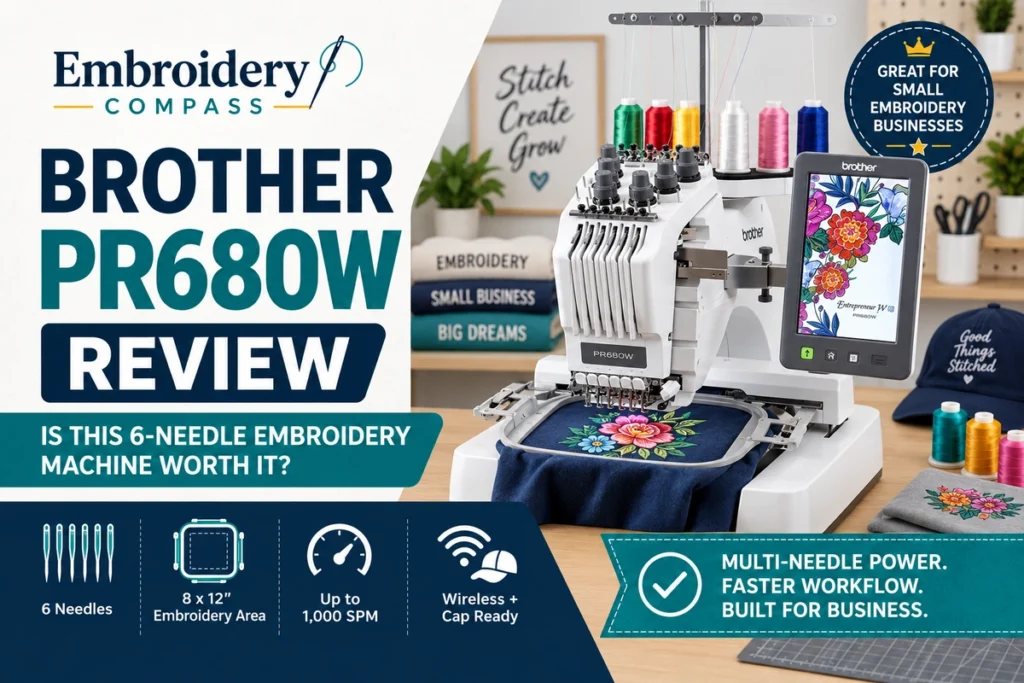
If you are outgrowing a single-needle embroidery machine, the Brother PR680W represents a major step toward a more production-focused setup. Instead of stopping to rethread for every color change, this dedicated embroidery machine keeps six needles threaded and ready, combines them with an 8 x 12-inch maximum embroidery area, and can run at up to 1,000 stitches per minute.
Those capabilities make the PR680W especially interesting for growing home businesses, personalization shops, logo work and embroiderers handling repeat multicolor orders. But it is also a substantial investment, weighs about 84 pounds, does not perform conventional sewing, and optional accessories can add to the total cost.
In this Brother PR680W review, we look at its six-needle workflow, embroidery area, speed, placement tools, cap capability, wireless features and business-oriented functions to determine who can realistically benefit from the upgrade.
As an Amazon Associate I earn from qualifying purchases. If you buy through links on this page, we may earn a small commission at no extra cost to you.

Brother PR680W Review: Quick Verdict
The Brother PR680W is worth considering when embroidery has moved beyond an occasional hobby and thread changes, repeat jobs and production time are becoming real constraints. Six needles are the key reason to buy it. You can keep multiple thread colors loaded, assign colors to needle bars and allow many multicolor designs to progress with far less manual intervention than on a conventional single-needle machine.
Its 8 x 12-inch embroidery field, up-to-1,000-SPM speed, free-arm design, large 10.1-inch display, crosshair positioning laser and wireless workflow reinforce that productivity focus. For a growing embroidery business, these features can matter more than simply having a larger library of built-in designs.
However, a beginner making occasional monograms or small projects probably does not need this level of machine. A less expensive single-needle model can be a more sensible starting point. The PR680W makes the strongest case when you already know embroidery, expect regular orders, or specifically need a multi-needle workflow.
Brother PR680W Specifications
| Machine type | Dedicated multi-needle embroidery machine |
| Needles | 6 |
| Maximum embroidery area | 8 x 12 inches (12 x 8 inches depending on orientation) |
| Maximum embroidery speed | Up to 1,000 stitches per minute |
| Display | 10.1-inch HD color LCD touchscreen |
| Built-in embroidery designs | 100 |
| Built-in lettering fonts | 50 |
| Monogramming font styles | 18 |
| Frame-pattern combinations | 140 |
| Wireless | Yes |
| USB | Yes |
| Cap-frame capability | Yes; optional cap-frame equipment required |
| Included frames | 8 x 12, 5 x 7, 4 x 4, and 1.5 x 2 inches |
| Machine weight | Approximately 83.8 lb |
Specifications are based on current Brother documentation. Features and included accessories can change, so confirm the current package before purchasing.
What Makes a 6-Needle Machine Different?
The most important difference between the PR680W and a home single-needle embroidery machine is not simply speed or hoop size. It is workflow.
On a single-needle machine, a six-color design can require repeated stops while you remove one thread color and load the next. The PR680W has six needle bars, so six colors can remain threaded simultaneously. For a design using those assigned colors, the machine can move from one needle to another rather than requiring you to manually rethread at each change.
That does not mean every design becomes completely unattended. A design with more than six required colors can still require intervention, and thread or bobbin issues can occur. But for common logos, names and multicolor designs, reducing repeated rethreading can make the production process considerably smoother.
This distinction is why the PR680W belongs in a different buying category from machines such as the PE900. If you are comparing Brother models generally, our guide to the best Brother embroidery machines explains where the PE, SE and PR families fit.
Embroidery Speed and Production Efficiency
Brother rates the PR680W at up to 1,000 stitches per minute with standard embroidery frames. High stitch speed alone does not guarantee that every design will run at maximum speed—fabric, thread, stitch density and design characteristics can all affect the appropriate setting—but the machine has substantially more production intent than a typical entry-level home model.
For a business, the bigger efficiency gain can come from combining that speed with six pre-threaded needles. If you embroider the same multicolor logo repeatedly, reducing manual thread changes between colors can save operator attention across a batch.
The PR680W also includes Color Sort, Color Grouping and Color Management functions. Color Sort can reduce unnecessary color changes when combining designs, while the editing tools help organize color regions before stitching. These features are particularly useful when efficiency matters across repeated or combined designs.
8 x 12-Inch Embroidery Area
The maximum embroidery field is 8 x 12 inches, giving the PR680W significantly more working room than common 4 x 4 or 5 x 7 home embroidery machines. That opens the door to larger logos, jacket backs, decorative panels, tote bags and other designs that may not fit smaller hoops without splitting the design.
Brother includes four frame sizes: 8 x 12, 5 x 7, 4 x 4 and 1.5 x 2 inches. Having smaller frames as well as the maximum-size frame is useful because not every job benefits from using a large hoop. Small names, monograms and compact logos can be handled with a frame better matched to the design.
Still, 8 x 12 inches is not unlimited. Buyers planning very large commercial designs should compare the PR680W’s field with larger multi-needle machines before deciding.
Free-Arm Design for Garments and Tubular Items
One of the practical advantages of the PR680W is its free-arm multi-needle format. It is designed to make it easier to position garments and tubular items without forcing excess material under a large flat sewing bed.
That matters for business-oriented projects such as shirts, jackets, bags, sleeves and other finished items where access to the embroidery location can be awkward on a conventional flatbed machine. You still need to hoop and stabilize each item correctly, but the physical layout is better suited to garment embroidery than many home machines.
Can the Brother PR680W Embroider Hats and Caps?
Yes. The PR680W has cap-frame capability, which is an important advantage for businesses that want to offer embroidered caps. However, buyers should understand that the standard package does not simply turn into a cap setup by itself. Compatible cap-frame equipment is an additional purchase.
Brother lists a lower speed range for cap work than for standard flat frames: cap-frame embroidery operates in the 400–600 stitches-per-minute range. That is still useful for production, but it is important not to assume the machine’s headline 1,000-SPM maximum applies to every cap job.
If hats are a major part of your planned product line, compare the complete cost of the machine plus the appropriate cap system rather than evaluating only the base machine. Our best embroidery machines for hats and caps guide can also help put dedicated cap capability in context.
Crosshair Laser Makes Placement Easier
Precise placement becomes increasingly important when embroidering customer garments. A design that is stitched cleanly but positioned incorrectly can still ruin an item.
The PR680W’s Crosshair Embroidery Droplight Laser projects positioning guidance onto the material to help you see where the needle will drop. Brother specifies accuracy of approximately ±0.5 mm from the needle-drop point on materials up to 1 mm thick.
This is not a substitute for measuring, marking and careful hooping, but it provides another visual reference before committing to the stitch-out. For logos, monograms and personalized items, that can be a genuinely useful production feature rather than a novelty.
10.1-Inch Touchscreen and On-Screen Editing
The 10.1-inch high-definition color LCD is one of the most noticeable upgrades over smaller home embroidery machines. A larger display makes it easier to preview designs, work through menus and perform editing without trying to interpret everything on a compact screen.
The PR680W supports on-screen editing, drag-and-drop positioning, design grouping, text editing, rotation in fine increments, automatic density adjustment and zooming in edit mode. It also provides a realistic preview and stitch simulator to help you review a project before stitching.
For a shop operator, the screen also supports shortcuts and security lock modes. Administrator and operator access can be separated, which becomes more relevant when more than one person uses the machine.
Wireless Design Transfer and Machine Monitoring
The PR680W is wireless enabled. With Brother’s Design Database Transfer software, compatible designs can be sent from a computer over the local wireless network rather than relying only on a USB drive.
Brother also supports My Stitch Monitor, which can provide project-status notifications such as thread-change alerts and completion notices. This does not make embroidery fully unattended, but it can reduce the need to stand directly beside the machine throughout every stitch-out.
For a larger operation, Brother says up to 10 compatible machines can be linked wirelessly when used with PE-Design 11, which is an additional purchase. A single-machine home business may never need that capability, but it gives the PR680W a clearer path into a multi-machine workflow.
Built-In Designs and Lettering
The machine includes 100 embroidery designs, 50 lettering fonts, 18 monogramming font styles and 140 frame-pattern combinations. These provide useful starting material for personalization, names and decorative work.
However, we would not choose a machine in this price class primarily because of its built-in design count. Business buyers are more likely to use purchased files, custom digitized logos or their own design library. The PR680W’s stronger value lies in its needle system, placement, editing, connectivity and production workflow.
How Easy Is the Brother PR680W to Learn?
The PR680W is more complex than a basic single-needle embroidery machine, but Brother has clearly designed the interface to reduce the learning barrier. The large touchscreen provides on-screen help, and Brother’s documentation lists 24 built-in tutorial videos.
New owners still need to learn multi-needle threading, needle assignments, tension, hooping, stabilization, design placement and safe garment handling. Anyone entering commercial embroidery should also learn how stitch density, underlay and digitizing quality affect finished results.
So we would describe the PR680W as approachable for a motivated embroiderer, but not an entry-level purchase in the usual sense. Its controls can help with operation, but they do not remove the need to learn embroidery fundamentals.
Is the Brother PR680W Good for a Small Embroidery Business?
This is where the PR680W makes the most sense. A small business can benefit from six loaded colors, repeat-job efficiency, garment-friendly free-arm construction, an 8 x 12-inch field and up-to-1,000-SPM flat-frame speed.
Imagine repeatedly embroidering a company logo that uses several colors. On a single-needle machine, the operator may need to return for multiple manual thread changes during every item. With the PR680W, up to six required colors can already be loaded and assigned. Across a batch, that can reduce repetitive intervention and make the operator’s time available for hooping, trimming, preparing the next garment or handling another part of the business.
That does not automatically make the PR680W profitable. Profitability depends on your order volume, pricing, consumable costs, digitizing, mistakes, labor and how effectively the machine is kept working. If you are evaluating machines specifically for paid work, see our best embroidery machines for small business guide for broader options.
What the Brother PR680W Does Well
1. Six Needles Reduce Repetitive Thread Changes
This is the machine’s defining advantage. Keeping six colors ready can make multicolor and repeat work more efficient than using a single-needle model.
2. Strong Speed for a Semi-Professional Workflow
Up to 1,000 stitches per minute gives the PR680W the pace expected from a serious multi-needle machine while still fitting into a relatively compact footprint.
3. Useful 8 x 12-Inch Maximum Field
The field is large enough for many garment, bag and decorative projects while four included frame sizes provide flexibility for smaller work.
4. Business-Friendly Placement and Monitoring
The crosshair laser, large display, wireless transfer and My Stitch Monitor support address practical workflow issues rather than merely adding decorative features.
5. Cap and Tubular-Item Potential
Free-arm construction and optional cap-frame capability expand the range of products a growing personalization business can offer.
What Could Be Better?
The Investment Is Significant
The PR680W sits well above ordinary home embroidery machines financially. Buyers should evaluate expected workload and revenue rather than purchasing six needles simply because they are appealing.
Cap Equipment Costs Extra
The machine supports cap embroidery, but compatible cap-frame equipment is optional. Businesses planning to sell hats should include those accessories in their startup budget.
It Is Embroidery-Only
The PR680W is not a conventional sewing machine. If you need one machine for garment construction, alterations and embroidery, a sewing-and-embroidery combination model serves a different purpose.
Six Needles Are Not Unlimited
Six colors cover many designs efficiently, but complex designs can use more than six colors. Those jobs can still require thread changes or reassignment.
It Needs a Dedicated Workspace
At roughly 84 pounds, this is not a machine most owners will want to pack away after every project. A stable, dedicated workstation is the practical approach.
Brother PR680W vs a Single-Needle Embroidery Machine
| Consideration | Brother PR680W | Typical Home Single-Needle Machine |
|---|---|---|
| Needles ready at once | 6 | 1 |
| Multicolor workflow | Can automatically switch among loaded needles | Usually requires manual rethreading for each color |
| Maximum speed | Up to 1,000 SPM | Varies; generally lower on many home models |
| Garment access | Free-arm multi-needle format | Depends on machine design |
| Cap capability | Yes, with optional equipment | Often limited or unavailable |
| Learning curve | Higher | Usually easier for a first-time user |
| Investment | High | Much broader range of lower-cost choices |
| Best fit | Growing business and higher-volume embroidery | Hobby, learning and lighter production |
If you are still producing comfortably on one needle and do not mind changing thread, upgrading may not be urgent. The PR680W becomes more compelling when manual color changes and operator attention are limiting how much work you can complete.
Brother PR680W Pros and Cons
Pros
- Six-needle system improves multicolor workflow
- Up to 1,000 stitches per minute with standard frames
- 8 x 12-inch maximum embroidery area
- Four embroidery frames included
- 10.1-inch HD color touchscreen
- Crosshair laser assists precise placement
- Wireless design transfer
- My Stitch Monitor support
- Free-arm construction for garments and tubular items
- Cap-frame capability
- Automatic needle threading and thread cutting
- Upper and bobbin thread sensors
Cons
- Substantial investment for casual users
- Embroidery-only; no conventional sewing
- Optional cap setup adds cost
- Six colors do not cover every complex design
- Heavier and less portable than home machines
- Multi-needle operation has a learning curve
- 8 x 12 field may still be limiting for very large commercial designs
Who Should Buy the Brother PR680W?
The PR680W is particularly well suited to:
- Growing home embroidery businesses that are spending too much time on manual thread changes.
- Personalization shops producing names, monograms and multicolor logos.
- Garment embroiderers who benefit from free-arm access.
- Businesses adding caps and willing to purchase the appropriate optional cap equipment.
- Experienced hobbyists moving into paid work who already understand embroidery fundamentals.
- Operators handling repeat orders where six pre-threaded colors can improve workflow.
Who Should Skip It?
You may be better served by another machine if:
- You are completely new to machine embroidery and are not yet sure you will use it regularly.
- You mostly make occasional small, one- or two-color projects.
- You need conventional sewing as well as embroidery from the same machine.
- Your current single-needle machine is comfortably keeping up with your workload.
- You need an embroidery field larger than 8 x 12 inches for your core products.
- Your budget does not leave room for stabilizer, thread, digitizing, blanks and optional accessories after buying the machine.
Frequently Asked Questions
Is the Brother PR680W a commercial embroidery machine?
The PR680W is a six-needle, business-oriented embroidery machine designed for substantially more productive workflows than ordinary home single-needle models. Whether you call it commercial or semi-professional, it is clearly aimed at serious embroidery and small-business use. Larger production shops may still prefer machines with more needles, larger fields or heavier industrial configurations.
How many needles does the Brother PR680W have?
It has six needles. Multiple thread colors can remain loaded so the machine can switch among assigned needles during multicolor embroidery.
What is the largest hoop size for the Brother PR680W?
The PR680W’s maximum embroidery area is 8 x 12 inches. Brother includes an 8 x 12-inch frame along with 5 x 7, 4 x 4 and 1.5 x 2-inch frames.
How fast is the Brother PR680W?
Brother specifies embroidery speeds up to 1,000 stitches per minute with standard frames. Cap-frame work uses a lower supported range of 400–600 stitches per minute.
Can the Brother PR680W embroider hats?
Yes. The PR680W supports cap embroidery with compatible optional cap-frame equipment. The standard included frame set does not include the cap system.
Does the Brother PR680W sew?
No. It is a dedicated embroidery machine and does not replace a conventional sewing machine for garment construction or general sewing.
Does the Brother PR680W have Wi-Fi?
Yes. The PR680W is wireless enabled and supports wireless design transfer through Brother’s Design Database Transfer workflow. It also works with My Stitch Monitor for compatible project-status notifications.
Is the Brother PR680W good for beginners?
It can be learned by a committed beginner, and Brother provides on-screen help and built-in tutorials, but it is not our first choice for someone casually exploring embroidery. Its price, six-needle workflow and business-oriented feature set make more sense for experienced users or beginners who have a clear production plan.
Is the Brother PR680W worth the money?
It can be worth the investment when six needles, faster production, garment access and reduced manual thread changing solve real workflow problems for you. For occasional hobby embroidery, those advantages are unlikely to justify the cost. The decision should be based on workload and intended use rather than the feature list alone.
Final Verdict: Is the Brother PR680W Worth It?
The Brother PR680W is a compelling upgrade for an embroiderer who has reached the point where a single needle is slowing down production. Six needles, an 8 x 12-inch field, up-to-1,000-SPM speed, free-arm construction, wireless transfer, a large touchscreen and precise crosshair placement combine into a machine built around a more efficient embroidery workflow.
Its value is easiest to justify in a growing business. If you regularly produce multicolor logos, monograms, garments or repeat customer orders, reducing thread changes and operator intervention can matter every working day. Optional cap capability also gives a business room to broaden its product offering.
For an occasional hobbyist, however, the PR680W is more machine—and more investment—than necessary. A capable single-needle model will usually be easier to justify. The PR680W becomes worth serious consideration when your question changes from “Can my machine embroider this?” to “How efficiently can I produce the next ten?”
Embroidery Compass develops its recommendations through manufacturer documentation, specifications, feature comparisons and practical buying research. We do not claim hands-on testing unless a machine has actually been personally tested.