Best Embroidery Machines for Hats: 5 Cap Embroidery Picks
Disclosure: As an Amazon Associate I earn from qualifying purchases. If you buy through links on this page, we may earn a small commission at no extra cost to you.
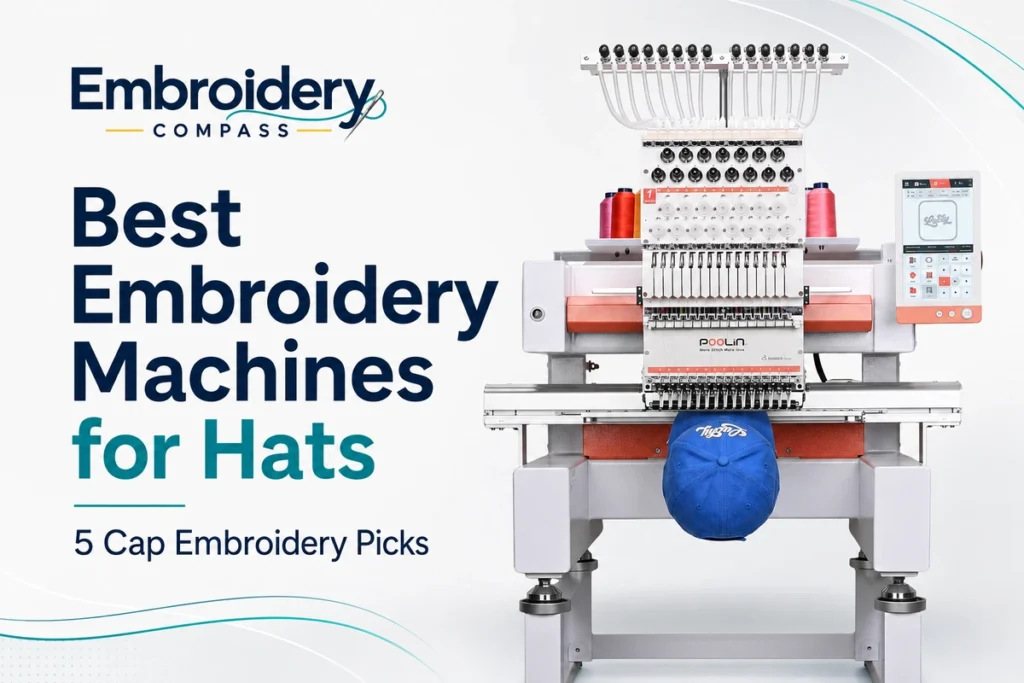
Hat embroidery puts different demands on a machine than ordinary flat embroidery. A machine that performs well on shirts and towels is not automatically the best choice for structured baseball caps, curved fronts or 3D puff logos.
The curved shape of a cap, center seam, limited embroidery height and need for a dedicated cap frame can make positioning and stitch quality more challenging. For anyone planning to embroider hats regularly—especially for customers—a multi-needle machine with a proper cap driver can make the workflow much easier.
Based on our comparison of cap systems, needle counts, hat-specific embroidery speeds, working areas and commercial features, our best embroidery machine for hats is the Smartstitch S-1501. Its 15-needle configuration, 270-degree cap driver, 280 x 75 mm cap embroidery area and production-oriented controls make it a strong all-around choice for businesses producing both hats and flat garments.
The PooLin EOV is especially interesting for shops where caps are the main product, while the larger PooLin EOX offers more flexibility for businesses handling hats and oversized flat designs. The Smartstitch S-1201 Plus provides a more compact 12-needle alternative, and the Brother PR680W is our premium Brother pick for users who value its six-needle ecosystem and advanced interface.
Best Embroidery Machines for Hats at a Glance
| Embroidery Machine | Best For | Needles | Cap System | Max Cap Speed |
|---|---|---|---|---|
| Smartstitch S-1501 | Best Overall for Hats | 15 | 270° cap driver | Up to 850 SPM |
| PooLin EOV | Best Hat-Focused Commercial Pick | 15 | Commercial cap system | Up to 850 SPM |
| PooLin EOX | Best for Hats + Large Flat Designs | 15 | Cap embroidery support | Up to 850 SPM |
| Smartstitch S-1201 Plus | Best 12-Needle Value for Hats | 12 | 270° cap driver | Up to 850 SPM |
| Brother PR680W | Best Premium Brother Pick | 6 | Optional cap-frame system | 400–600 SPM |
Do not choose a hat embroidery machine by needle count alone. Cap-frame design, available embroidery height, stitch speed on curved items, positioning tools, thread management and support can be just as important as the number of colors you can keep threaded.
How We Chose the Best Embroidery Machines for Hats and Caps
This guide focuses specifically on cap embroidery. That makes our priorities different from our general best embroidery machines guide and our small-business embroidery machine comparison.
For hats, we gave extra weight to:
- Dedicated cap system: A proper cap driver and cap frame are much more important than simply attaching a small flat hoop.
- Cap embroidery area: Hat designs are limited by the usable curved embroidery field, particularly vertically.
- Needle count: Multiple needles reduce manual rethreading when producing multi-color logos.
- Cap-specific speed: Machines often run caps slower than flat garments, so hat speed deserves separate attention.
- Structured-cap capability: Baseball caps have seams, stiffness and curved surfaces that create additional resistance.
- Positioning: Accurate placement is particularly important because a crooked logo on the front of a cap is immediately noticeable.
- 3D puff potential: Businesses selling raised foam lettering need a machine and cap system capable of handling the extra material and stitch density.
- Thread trimming and color changes: Automation becomes increasingly valuable when producing repeated customer orders.
- Flat embroidery versatility: Most businesses will eventually want to embroider shirts, bags or jackets as well as hats.
Our recommendations are based on manufacturer documentation, specifications, feature comparisons and practical buying considerations. We do not claim hands-on testing unless a machine has actually been personally tested by our editorial team.
1. Smartstitch S-1501 — Best Overall Embroidery Machine for Hats

Best for: Growing embroidery businesses that expect hats to be an important product but still need a versatile machine for shirts, jackets, bags and other flat items.
The Smartstitch S-1501 earns our best overall position because its cap capabilities are backed by a broader commercial platform rather than being treated as an occasional accessory.
It uses 15 needles, allowing a wide selection of thread colors to remain loaded at the same time. That matters for hats because business logos, sports designs and branded caps often use multiple colors, and manually changing thread between colors can slow repeated production significantly.
The S-1501 uses a 270-degree cap driver with a listed cap embroidery area of approximately 280 x 75 mm. Smartstitch lists maximum cap embroidery speed at up to 850 stitches per minute, compared with up to 1,200 SPM for flat embroidery.
Why the S-1501 Stands Out for Cap Embroidery
The key advantage is that this is not merely a home machine capable of accepting a hat accessory. Its cap driver is part of a production-oriented multi-needle workflow.
The wide cap system gives the machine room to embroider across the curved front of compatible caps, while the 15-needle head lets commonly used colors remain permanently threaded.
For a business producing repeated company logos, team hats or personalized headwear, that combination can reduce the amount of hands-on intervention required between jobs.
15 Needles Are Useful for Repeated Hat Orders
A cap logo might use six, eight or more thread colors. With 15 needles available, a business can keep a broad everyday palette installed and assign those colors to designs without rethreading the machine for every job.
This is particularly useful when moving between customer orders that use common black, white, red, blue, gold and other frequently requested thread colors.
Large Flat Embroidery Area Adds Versatility
Although this guide is about hats, most embroidery businesses do not sell hats alone. The S-1501 has a large flat embroidery area of approximately 13.7″ x 19.7″, which gives it substantial flexibility for jackets, bags, apparel and other larger projects.
That makes it more attractive as an all-around business investment than purchasing equipment designed only around one narrow product category.
Smartstitch S-1501 Key Specifications
- Needles: 15
- Heads: 1
- Flat embroidery area: 13.7″ x 19.7″
- Cap embroidery area: 280 x 75 mm
- Cap driver: 270° embroidery
- Maximum flat speed: 1,200 SPM
- Maximum cap speed: 850 SPM
- Touchscreen: 12 inches
- Pattern transfer: USB / Wi-Fi
- Supported listed formats: DST / DSB
- Laser positioning: Yes
- Automatic thread trimming: Yes
- Approximate machine weight: 209 lb
What Could Be Better
The S-1501 is a substantial commercial machine. At roughly 209 pounds, it needs a dedicated workspace and should not be treated like a portable home embroidery machine.
Its 15-needle system also introduces more setup and maintenance responsibility than a single-needle machine. New owners must learn cap framing, tension, needle selection, bobbin management and multi-needle threading before expecting efficient production.
Our verdict: The Smartstitch S-1501 is our best overall choice for hats because it combines a genuine 270-degree cap system with 15 needles and enough flat-embroidery capacity to serve as the main machine in a growing embroidery shop.
2. PooLin EOV — Best Hat-Focused Commercial Embroidery Machine
Best for: Small businesses where structured hats, caps and 3D puff embroidery are a major part of the product lineup.
The PooLin EOV stands out because PooLin positions this 15-needle commercial machine specifically around hat production. Rather than adding caps as an afterthought, its marketing and mechanical design emphasize headwear, thick fabrics and repeated commercial orders.
The EOV combines 15 needles with a commercial cap system, allowing businesses to move between multi-color hat logos without manually changing thread after every color.
PooLin lists embroidery speeds up to approximately 850 SPM for hats, with higher speeds available for flat embroidery.
Designed Around Structured Caps
Structured baseball caps can be difficult because the machine has to stitch through a stiff front panel while following a curved surface. The center seam can add another layer of resistance exactly where many logos need to be placed.
The EOV is designed around commercial hat work rather than simply flat garments, which makes it particularly interesting to businesses selling company caps, team hats, branded merchandise and custom headwear.
A Strong Option for 3D Puff Embroidery
Raised 3D puff lettering is popular on baseball caps because it creates a dimensional, premium appearance. Foam is placed underneath the stitching so dense satin stitches can create the raised effect.
This technique increases the demands on the needle, thread, digitizing and machine setup. PooLin specifically discusses the EOV in connection with 3D foam embroidery on caps and other thick materials, making it a more relevant choice for businesses planning to sell that style regularly.
15 Needles Help Keep Orders Moving
Multi-color hat orders are where a 15-needle head becomes particularly useful. You can assign frequently used colors to permanent needle positions and reduce the need to stop between designs.
This advantage grows when the same logo is stitched across dozens of caps because the machine can work through the programmed color sequence repeatedly with less operator involvement.
PooLin EOV Key Features
- Machine type: Commercial multi-needle embroidery
- Needles: 15
- Flat embroidery area: approximately 9.5″ x 14″
- Maximum flat embroidery speed: up to 1,200 SPM
- Maximum hat speed: up to 850 SPM
- Cap embroidery system: Yes
- Wi-Fi design transfer: Yes
- USB design transfer: Yes
- Automatic color changes: Yes
- Automatic thread trimming: Yes
- Thread-break detection: Yes
- 3D puff suitability: Yes
What Could Be Better
The EOV makes the most sense when hats are genuinely important to your business. If you mainly produce large jacket backs, oversized tote designs or other flat embroidery, the larger field of the PooLin EOX may provide greater flexibility.
As with other commercial machines, new operators should expect a learning period for cap framing, tension and digitizing. Purchasing a machine capable of 3D puff does not automatically make every design suitable for foam embroidery—the design itself must be digitized correctly for the technique.
Our verdict: The PooLin EOV is our most hat-focused recommendation. It is particularly compelling for a business that expects structured caps and 3D puff logos to make up a significant share of customer orders.
3. PooLin EOX — Best for Hats and Large Flat Embroidery


Best for: Businesses that want strong hat capability but also need a much larger embroidery field for jackets, bags and oversized flat projects.
The PooLin EOX is the better fit when caps are important but not the only product you expect to sell.
Its biggest advantage over the EOV is its much larger 350 x 500 mm embroidery area, approximately 14″ x 20″. PooLin lists the EOX at up to 1,200 stitches per minute on flat embroidery and up to 850 SPM for hats.
Like the EOV, it uses a 15-needle single-head platform, providing enough permanently threaded colors for complex commercial designs.
Why the Larger Area Matters
A hat logo may use only a relatively small embroidery area, so buying an oversized flat field strictly for cap work would not make sense.
The EOX becomes valuable when a business wants one primary machine for multiple revenue streams. The same machine can handle caps and then move to much larger jacket-back, tote-bag or apparel designs without immediately encountering a restrictive flat embroidery field.
That flexibility may be more important than specialized hat optimization for a general custom-apparel shop.
15 Needles for Commercial Color Work
Fifteen needles provide enough positions to keep a broad palette ready throughout the working day. For repeated customer logos, the advantage is not just fewer thread changes—it also means faster movement between different jobs when common colors stay assigned to familiar needle positions.
PooLin EOX Key Features
- Machine type: 15-needle commercial embroidery
- Needles: 15
- Maximum flat embroidery area: 350 x 500 mm / approximately 14″ x 20″
- Maximum flat embroidery speed: 1,200 SPM
- Maximum hat speed: 850 SPM
- Hat embroidery support: Yes
- Wi-Fi design transfer: Yes
- Commercial control system: Yes
- Automatic color changes: Yes
- Thread-break detection: Yes
- Automatic trimming: Yes
EOV vs EOX for Hat Embroidery
Choose the EOV if caps are at the center of the business and you want PooLin’s more hat-focused model.
Choose the EOX if hats are one important product category among several and you expect to use the much larger flat embroidery area regularly.
Our verdict: The EOX is a strong choice for a custom-apparel business that needs genuine hat capability without sacrificing room for large flat embroidery projects.
4. Smartstitch S-1201 Plus — Best 12-Needle Value for Hats

Best for: Home studios and growing businesses that want commercial cap capability without moving immediately to a larger 15-needle machine.
The Smartstitch S-1201 Plus gives hat businesses an interesting middle ground. It has fewer needles than the 15-needle S-1501, EOV and EOX, but its 12-needle configuration is still a major step above single-needle or six-needle machines for multi-color cap work.
For hats, Smartstitch specifies a 270-degree cap driver, approximately 280 x 75 mm cap embroidery area and maximum cap speed up to 850 stitches per minute.
The machine also provides a 10-inch touchscreen, pinpoint laser positioning, USB/Wi-Fi transfer and up to 1,200 SPM on flat embroidery.
Why 12 Needles Can Be Plenty for Hat Work
Not every cap design uses 15 colors. In many small-business workflows, 12 needles provide enough capacity to keep the most common thread colors ready and still complete multi-color logos without constant manual changes.
The important question is not whether 15 is mathematically better than 12. It is whether your normal designs use enough colors to benefit from three additional permanently threaded positions.
Pinpoint Laser Helps With Placement
Cap placement can be unforgiving. If a front logo sits too high, too low or slightly off center, the mistake is immediately visible when someone wears the hat.
The S-1201 Plus includes pinpoint laser positioning, which can help the operator verify placement before stitching. It does not replace careful framing, but it gives another reference point during setup.
Smartstitch S-1201 Plus Key Specifications
- Needles: 12
- Flat embroidery area: 11.8″ x 15.7″
- Cap embroidery area: 280 x 75 mm
- Cap driver: 270° embroidery
- Maximum flat speed: 1,200 SPM
- Maximum cap speed: 850 SPM
- Touchscreen: 10 inches
- Design transfer: USB / Wi-Fi
- Supported listed formats: DST / DSB
- Laser positioning: Yes
- Automatic thread trimming: Yes
- Approximate machine weight: 114.6 lb
Where It Falls Behind a 15-Needle Machine
The obvious tradeoff is three fewer thread positions. If your business regularly produces highly colorful logos or you want a very broad permanent thread palette loaded all day, 15 needles provide more flexibility.
Its flat embroidery area is also smaller than the S-1501 and PooLin EOX. That matters less for caps but may influence your decision if large flat embroidery is another major part of the business.
Our verdict: The S-1201 Plus is a strong value-oriented hat machine for a growing studio. Twelve needles, an 850-SPM cap speed and a dedicated 270-degree cap system provide substantial commercial capability without forcing every buyer into a larger 15-needle platform.
5. Brother PR680W — Best Premium Brother Embroidery Machine for Hats

Best for: Businesses that prefer Brother’s premium multi-needle platform and value its large touchscreen, positioning tools and mature embroidery workflow.
The Brother PR680W is different from the other machines in this guide because it uses only six needles. On paper, that appears to put it at a disadvantage against 12- and 15-needle alternatives.
However, needle count is only one part of the hat-embroidery experience. Brother combines its six-needle system with a large 10.1-inch display, embroidery positioning features, extensive on-machine editing, automatic thread management and compatibility with dedicated cap-frame accessories.
Brother specifies cap sewing speeds between approximately 400 and 600 stitches per minute, which is slower than the maximum hat speeds listed for the commercial Smartstitch and PooLin machines in this guide.
Why Consider a Six-Needle Machine for Hats?
Six needles can be enough when your normal logos use relatively few colors. A business producing mostly two-, three- or four-color corporate logos may value Brother’s interface and workflow more than having another nine thread positions.
The machine also allows individual needle attributes and thread-color assignments to be managed through its control system, which can make repeat jobs easier once the workflow is established.
Large 10.1-Inch Display
The PR680W’s 10.1-inch high-definition LCD is one of its strongest features. On-machine editing includes functions for moving, rotating, resizing and managing design colors.
That is useful for cap embroidery because placement often needs to be checked carefully before the machine begins stitching on the curved front panel.
Brother PR680W Key Specifications
- Needles: 6
- Maximum flat embroidery area: 8″ x 12″
- Maximum general embroidery speed: 1,000 SPM
- Listed cap sewing speed: 400–600 SPM
- Display: 10.1-inch color LCD
- Built-in embroidery designs: 100
- Built-in lettering fonts: 50
- Wireless connectivity: Yes
- USB connectivity: Yes
- Automatic thread cutter: Yes
- Jump-stitch thread trimming: Yes
- Cap-frame compatibility: Yes
- Positioning marker: Yes
What Could Be Better
The PR680W is the least attractive choice here if your main priority is maximum thread capacity or maximum cap production speed. Six needles require more thread changes on complex designs than a 12- or 15-needle machine.
Buyers should also confirm exactly which cap-frame accessories are included with the specific package they are considering. The machine supports cap embroidery, but optional accessories can vary by package and seller.
Our verdict: The PR680W is best for a buyer who specifically wants Brother’s premium six-needle ecosystem. It is not our value or production-speed winner, but its polished interface, positioning features and established multi-needle workflow make it a legitimate premium option for cap embroidery.
Smartstitch S-1501 vs PooLin EOV vs PooLin EOX for Hats
| Feature | Smartstitch S-1501 | PooLin EOV | PooLin EOX |
|---|---|---|---|
| Needles | 15 | 15 | 15 |
| Hat Focus | Strong all-around cap system | Most hat-focused | Hats + large flat work |
| Max Hat Speed | 850 SPM | 850 SPM | 850 SPM |
| Flat Area | 13.7″ x 19.7″ | Approx. 9.5″ x 14″ | Approx. 14″ x 20″ |
| Best For | All-around embroidery business | Cap-heavy business | Diverse commercial projects |
If hats are the main product, the PooLin EOV deserves particular attention. If you need the machine to handle almost everything a growing embroidery business receives, we prefer the broader versatility of the Smartstitch S-1501.
The PooLin EOX makes the most sense when the business regularly alternates between hats and large flat embroidery.
What Makes Hat Embroidery Different?
1. Caps Are Curved Instead of Flat
Most conventional embroidery begins with fabric stretched relatively flat inside a hoop. A baseball cap has a curved crown, which means the embroidery frame must hold the hat around that shape while the machine moves the design across the front.
This is why a proper cap driver matters. It is designed to rotate the framed cap through the embroidery area rather than forcing the hat into an ordinary flat hoop.
2. The Center Seam Creates Extra Resistance
Many structured caps have a thick center seam running directly through the area where a front logo is normally placed.
The needle has to penetrate this thicker section cleanly without excessive deflection or thread breakage. Correct needle type, stabilizer, digitizing and machine speed all become important when stitching across the seam.
3. Hat Embroidery Has Less Vertical Room
A machine may have a very large flat embroidery field but only a few inches of usable vertical space on a cap.
That is why the dimensions of the cap embroidery area matter more than the machine’s largest flat hoop when your primary product is headwear.
4. Cap Designs Often Stitch From the Center Out
Good cap digitizing typically considers the curved shape and center seam of the hat. Many front-cap designs are built so stitching progresses from the center outward, helping control shifting and distortion as the design forms.
This is one reason a design digitized for a flat shirt should not automatically be assumed to work perfectly on a structured cap.
Structured vs Unstructured Caps
Before buying a machine or digitizing a design, it helps to understand the type of hat you plan to embroider.
Structured Caps
Structured caps contain stiff material behind the front panels so the crown keeps its shape even when the hat is not being worn.
These caps are popular for company logos and sports-style embroidery but create more resistance for the needle. The center seam and stiff front can also increase the importance of proper framing and needle selection.
Unstructured Caps
Unstructured hats have softer front panels and collapse more easily. They can be easier to frame in some situations but may require careful stabilization because the fabric itself provides less support.
Neither cap type is automatically easier in every design. The machine, frame, backing and digitizing must work together.
How to Choose an Embroidery Machine for Hats
1. Prioritize the Cap System Over Flat Hoop Size
If hats are your primary product, do not be distracted by a huge flat embroidery area unless you will actually use it.
Look first at the cap driver, supported cap frames, usable cap embroidery area and machine speed when running the cap attachment.
2. Think About the Number of Colors in Your Logos
Needle count becomes valuable when your normal designs use many colors.
If your business primarily stitches one- or two-color text, six needles may be enough. If your customers regularly submit complex company and team logos, 12 or 15 needles provide greater flexibility.
3. Check Hat Speed Separately From Flat Speed
Manufacturers often advertise the machine’s maximum flat embroidery speed prominently, but caps may run at a lower maximum speed because the curved frame and structured material place different demands on the system.
For example, several commercial machines in this guide reach up to 1,200 SPM on flat embroidery but list approximately 850 SPM for caps.
4. Consider 3D Puff Before Buying
If raised lettering and logos are central to your product line, consider the entire puff-embroidery workflow before purchasing.
You will need:
- A machine capable of handling structured caps reliably
- A stable cap-frame system
- Correct puff foam
- Appropriate needles and thread
- A design digitized specifically for 3D foam
- Enough stitch density to cover the foam cleanly
- Proper finishing to remove excess foam
A normal embroidery design is not automatically suitable for 3D puff simply because foam is placed underneath it.
5. Think About Your Non-Hat Orders Too
Even if caps bring customers through the door, those customers may later request polos, jackets, bags, patches and uniforms.
If you want one primary machine to handle most of the business, compare the flat embroidery field as well as the cap system.
Our best embroidery machines for small business guide looks at multi-needle machines from a broader production perspective.
Do You Need a Multi-Needle Machine for Hat Embroidery?
Not necessarily. It is possible to embroider some hats using compatible single-needle machines, specialty hoops and careful positioning.
However, a multi-needle commercial-style machine becomes much more attractive when hats are being produced repeatedly for customers.
| Feature | Single-Needle Setup | Multi-Needle Cap Machine |
|---|---|---|
| Initial cost | Lower | Higher |
| Thread colors ready | 1 | 6–15+ depending on machine |
| Cap frame | Varies by machine | Dedicated commercial systems common |
| Repeated orders | More manual intervention | More automated |
| Color changes | Manual | Automatic across loaded needles |
| Best use | Occasional hats / learning | Regular paid cap production |
If you are still learning embroidery and have not yet proven demand for hats, investing immediately in a large commercial machine may not be necessary. Our beginner embroidery machine guide covers more approachable starting options.
What Supplies Do You Need for Cap Embroidery?
The embroidery machine is only one part of a reliable hat setup. Depending on the cap style and design, you may also need:
- Commercial embroidery thread
- Correct cap needles
- Tear-away or other suitable backing
- Cap-specific stabilizer
- Water-soluble topping for appropriate materials
- 3D puff foam for raised designs
- Pre-wound bobbins
- Cap frames and cap driver
- Hooping/framing station
- Thread-trimming tools
- Digitized cap embroidery files
Visit our embroidery supplies and accessories guides for more help choosing stabilizers, needles, thread and other materials.
Common Hat Embroidery Mistakes to Avoid
1. Using a Flat-Garment Design Without Checking the Digitizing
A design created for a T-shirt or flat fabric may not stitch correctly on a curved structured cap. The stitching sequence, density and direction should account for the hat’s shape and center seam.
2. Placing the Design Too High
Every cap style has limits on how high the frame and needle can safely stitch. Trying to force a design above the machine’s usable area can create poor results or mechanical problems.
3. Ignoring the Center Seam
The center seam is one of the thickest areas of a structured cap. Designs crossing it should be digitized and stitched with that additional resistance in mind.
4. Framing the Cap Loosely
Movement during embroidery can distort lettering and borders. Secure framing and appropriate backing help keep the cap stable as the driver moves around the curved surface.
5. Running Every Design at Maximum Speed
A machine’s maximum cap speed is not a requirement. Dense designs, thick seams, small lettering and 3D puff may produce cleaner results at a reduced speed.
Which Hat Embroidery Machine Fits Your Needs?
Choose the Smartstitch S-1501 if:
You want a 15-needle commercial machine that handles hats well but also provides a large flat embroidery area for a broad range of customer orders.
Choose the PooLin EOV if:
Caps, structured hats and 3D puff embroidery are central to your business and you want a machine positioned specifically around that workflow.
Choose the PooLin EOX if:
You need strong hat capability but also expect to produce large jacket, bag and apparel designs using a much larger flat embroidery field.
Choose the Smartstitch S-1201 Plus if:
You want a more compact 12-needle machine with a dedicated 270-degree cap system and do not expect to need all 15 thread positions.
Choose the Brother PR680W if:
You specifically prefer Brother’s six-needle platform, large touchscreen, editing tools and premium workflow and are comfortable with lower cap speed and fewer permanently loaded colors.
Frequently Asked Questions
What is the best embroidery machine for hats?
Our best overall pick is the Smartstitch S-1501. Its 15 needles, 270-degree cap driver, approximately 280 x 75 mm cap embroidery area and maximum cap speed up to 850 SPM make it well suited to regular commercial hat production while still offering a large flat embroidery area.
What is the best embroidery machine for a hat business?
For a business focused heavily on caps, the PooLin EOV deserves particular consideration because it is positioned specifically around structured hats, commercial cap production and 3D embroidery.
For a more diversified embroidery business, we prefer the Smartstitch S-1501 or PooLin EOX because their larger flat embroidery capabilities provide more flexibility beyond hats.
How many needles do I need for hat embroidery?
You do not need a specific minimum number of needles to embroider a hat. Needle count mainly affects how many thread colors can remain loaded simultaneously.
A six-needle machine can be sufficient for simple business logos, while 12- or 15-needle machines provide greater convenience for colorful designs and repeated commercial orders.
Can you embroider baseball caps with a regular embroidery machine?
Some home embroidery machines can embroider certain caps using compatible hoops or specialized accessories, but the workflow is usually more limited than using a commercial-style machine with a dedicated cap driver.
If hats are an occasional hobby project, a home setup may be sufficient. If hats are a regular paid product, a dedicated multi-needle cap system is generally more efficient.
What is a 270-degree cap frame?
A 270-degree cap system is designed to hold and rotate a hat around the curved embroidery area so the machine can stitch across a relatively wide section of the cap.
The exact usable embroidery dimensions still depend on the machine and frame, so 270 degrees should not be interpreted as unlimited stitchable space around the entire hat.
What speed should I use for hat embroidery?
There is no single ideal speed for every cap. Commercial machines may support hat speeds around 850 SPM, but dense logos, structured seams, small lettering and 3D puff can benefit from slower stitching.
Start with the machine manufacturer’s guidance and adjust based on the design, cap structure, needle, thread and stitch quality.
Can you do 3D puff embroidery on hats?
Yes. 3D puff embroidery is commonly used for raised lettering and logos on structured baseball caps.
The design needs to be digitized specifically for foam embroidery, and the machine must be set up with appropriate foam, needles, thread, stitch density and cap framing. Simply placing foam under a normal flat embroidery design does not guarantee good results.
Do I need special embroidery software for hats?
You do not necessarily need to digitize designs yourself, but hat designs should be prepared appropriately for curved embroidery and center seams.
You can outsource digitizing or learn to prepare files in-house. Our embroidery software guides cover software for editing and digitizing embroidery designs.
Is hat embroidery profitable?
Hat embroidery can become a useful product category for custom-apparel businesses because caps are commonly ordered for companies, sports teams, events, clubs and branded merchandise.
Profitability depends on blank-cap cost, digitizing, thread and backing costs, machine time, labor, order volume and the price customers are willing to pay. A faster machine alone does not guarantee a profitable business.
Final Verdict
The best embroidery machine for hats depends on whether caps are your main product or one part of a larger custom-embroidery business.
The PooLin EOV is our most hat-focused option and deserves particular attention from businesses planning structured caps and 3D puff work. The PooLin EOX is a better fit when you need hat production plus a much larger embroidery area for flat projects.
The Smartstitch S-1201 Plus provides a compelling 12-needle alternative for smaller studios, while the Brother PR680W serves buyers specifically interested in Brother’s premium multi-needle ecosystem and advanced control interface.
For the broadest range of growing hat and apparel businesses, however, our best overall pick is the Smartstitch S-1501. Its 15 needles, 270-degree cap driver, 850-SPM maximum cap speed, large flat embroidery area, Wi-Fi/USB transfer and commercial workflow provide the flexibility to build a serious cap business without limiting the machine to headwear alone.